
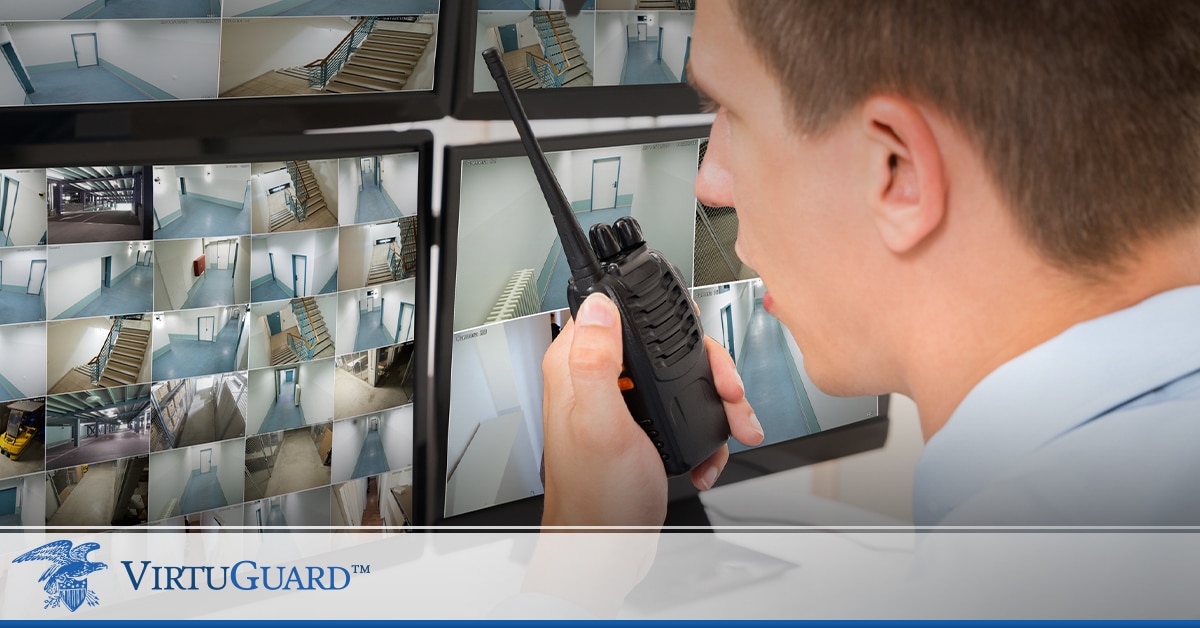
Remote monitoring and on-site guarding aren’t competing options, they’re complementary ones. Cameras and remote surveillance teams can watch more ground for less cost, while on-site guards bring judgment, presence, and hands-on response that a camera alone can’t. The strongest security plans combine both, using each to cover the other’s gaps.
There have been significant advancements in both the quality and affordability of remote surveillance services and equipment in recent years, making it a wise addition to almost any security plan. Does that mean cameras can replace on-premise guards? Definitely not. The best security strategy is a combination of the two, a symbiotic relationship where each enhances the abilities of the other and makes up for the other’s shortcomings.
Advantages of On-Premise Guards
Quick Response
In an emergency, a remote guard can alert the authorities or address a subject over an intercom. Still, an on-site guard is often better positioned to protect the safety of an employee or resident in the moment, or to physically prevent theft before it happens. The mere presence of a guard can act as a deterrent to wrongdoers before an incident ever occurs.
Engagement
When the same guards are in place day-to-day, the people who interact with them get to know them personally, and the guards get to know the people they serve. Employees and residents may be more likely to come forward and flag a potential problem or share an observation because of the trust that’s been built over time. By the same token, guards learn who belongs on a property and who doesn’t, and what’s normal versus what warrants a closer look. On-site guards bring a level of nuance and instinct to the job that’s difficult to replicate with remote monitoring alone.
Advantages of Remote Surveillance
It Can Be Placed Virtually Anywhere
Tight spaces, remote areas, hazardous sites: anywhere a camera can be mounted, remote monitoring is a viable security option. There’s little concern for the well-being of guards in a remote location, since only the camera is exposed to on-location risk. An on-site guard, by contrast, can be at risk due to severe weather conditions, hazardous materials, or high-crime areas.
It Keeps Costs Down
Remote video monitoring is typically far less expensive per hour than staffing a guard on-site, and it’s usually easier and less costly to add or replace a camera than it is to add or replace a guard. Cameras also don’t get injured, take sick days, or need time off, which makes remote coverage a practical way to extend monitoring across more hours and more locations without a proportional increase in cost.
So, What’s the Best Security Strategy?
Strengthen your security plan by combining remote and on-site guarding.
Place a security guard at your primary entrance during business hours, and let remote monitoring take over after hours, at secondary entrances, and across parking lots and the property perimeter. The same approach works well for auxiliary locations or hard-to-cover areas. Remote monitoring teams can also work in tandem with on-site guards, notifying them of incidents or observations that call for in-person investigation or response, so each layer strengthens the other rather than operating in isolation.
Frequently Asked Questions
Does remote monitoring replace on-site security guards?
No. Remote monitoring and on-site guards serve different purposes. Cameras extend coverage to more areas and hours at lower cost, but a physical guard provides in-the-moment response, deterrence, and the kind of situational judgment that comes from knowing a property and the people on it.
Is remote guarding more affordable than on-site guarding?
Generally, yes. Remote video monitoring is typically less expensive on a per-hour basis than staffing an on-site guard, and scaling coverage with cameras is usually simpler than scaling a guard workforce. Exact costs vary by site, coverage hours, and equipment, so a direct security assessment is the best way to get an accurate comparison for your property.
What’s the best way to combine on-site and remote security?
Most properties get the most value from layering the two: a guard stationed at the primary entrance during business hours, with remote monitoring covering after-hours periods, secondary entrances, parking areas, and the property perimeter. The remote team can also alert on-site guards when a situation calls for in-person response.
Want to learn more about how you can augment your security staff with remote security monitoring services?
Contact BOS Security to learn more about our VirtuGuard™ remote guarding services can protect your business at a fraction of the cost of human guards.