

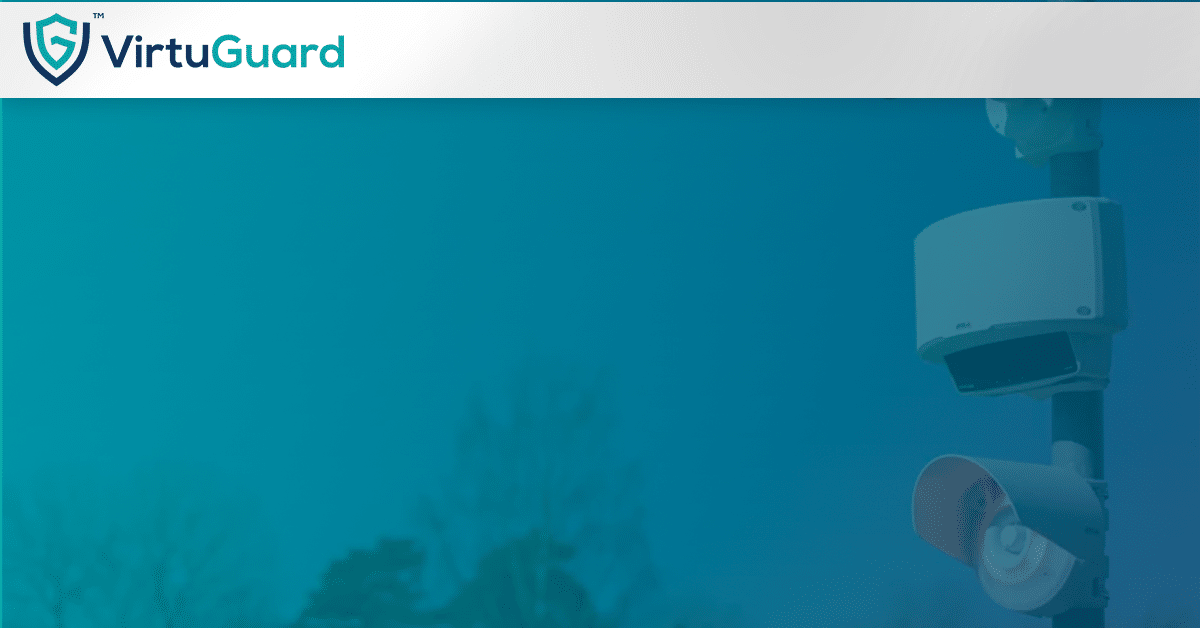
Radar reduces false alarms in security systems by detecting motion at a long range in any weather or lighting, then filtering out non-threats, like small animals, insects, debris, or shadows, before they ever reach a monitoring agent. Traditional security cameras can deter and capture suspicious activity, but they still miss threats in darkness, poor weather, and large, open areas. They’re also reactionary, only recording footage to be reviewed after an incident has already occurred, and they’re prone to false triggers from environmental noise.
Radar closes that gap. Axis Communications, an industry leader in network video, offers radar products that integrate with VirtuGuard™ Command Centers to add a proactive detection layer that cameras alone can’t replicate.
This article covers what radar is, how it works with video surveillance, how it compares to cameras and other detection technologies, what it costs, and how it integrates with VirtuGuard™.
Key Takeaways
- Radar reduces false alarms by filtering activity based on distance, speed, and object type; ignoring triggers that commonly set off cameras and infrared sensors (animals, insects, shadows, weather).
- Radar works day or night and, in any weather, including in fog, rain, and wind, conditions that degrade camera quality.
- Radar and video work together. Radar detects and localizes an object, then triggers the relevant camera(s) so a human Agent can visually verify it.
- Radar covers more ground per device than cameras, which reduces the number of devices needed for large outdoor areas.
- Axis Radar-Video Fusion Cameras combine both technologies in one device, so detection and visual verification happen without coordinating separate hardware.
- Remote monitoring cost depends on device count, camera count, monitoring hours, and activity level, not a flat rate.
What is Radar and How Does it Work?
Radar detects motion by emitting electromagnetic waves that bounce off objects and return to the device, revealing that something is present and moving. It was originally developed in the 1940s for military use and has since been adapted for weather forecasting, aviation, automotive systems, and physical security.
Axis radar uses this same principle to detect people and vehicles across open areas, day or night, regardless of weather.
How Does Radar Work with Video Surveillance?
Radar and video surveillance work together in a detect-then-verify sequence. The radar unit detects and locates an object, sends that alert (with position, direction, and speed) to the monitoring system. Then the system calls up the camera covering that specific location so a human agent can see and confirm what triggered the alert, all before any alarm reaches police or onsite staff. Radar handles detection across conditions where cameras alone struggle (darkness, distance, fog); cameras handle the visual confirmation that radar alone can’t provide. Neither replaces the other. They’re deployed as a paired system.
What Sets Radar Apart from Security Cameras?
- Radar doesn’t need clear visibility or ideal conditions to work effectively. It functions in darkness and it’s degraded by fog, rain, or wind. Camera quality drops in all three.
- Radar reports speed, direction, and exact position of a detected object. This automatically classifies objects as a person or a vehicle.
- Radar covers wide open outdoor areas more efficiently. A single radar unit can cover a range that would otherwise require multiple cameras.
- Radar produces meaningfully fewer false alarms. It can be configured to ignore activity outside a set distance, speed range, or object type, filtering out moving shadows, light beams, small animals, and insects before they trigger an alert.
Why is Radar Important for Security Solutions?
Radar detects activity that surveillance cameras and other devices are prone to miss or misidentify, without generating the false alarms that typically come with expanded coverage.
Axis Radar Technology
Axis Communications offers several radar devices, including Radar-Video Fusion Cameras, a single device that combines radar detection with video capture, so an object is detected and visually captured without needing to coordinate a separate camera and radar unit.
Radar vs. Camera Security Detection
Radar and cameras solve different problems. Radar detects reliably across distance, darkness, and weather. Cameras provide the visual detail needed to identify and respond to what radar detects. Most effective outdoor security setups use both rather than choosing one.
| Factor | Radar | Camera (video only) |
| Works in darkness | Yes, no light needed | Requires IR or low-light capability, image quality still drops |
| Works in fog, rain, and wind | Yes, it’s unaffected by weather conditions | There’s reduced visibility and false triggers |
| Coverage area per device | Wide open areas, often replacing multiple cameras | Limited by lens angle and distance; more devices needed for the same area |
| Object classification | Classifies person or vehicle, plus speed, direction, and position | Requires AI add-on to classify; accuracy varies with lighting |
| False alarm rate | Low, it’s filterable by distance, speed, and object type | Higher, it’s sensitive to animals, insects, shadows, and weather |
| Visual verification | None on its own, must be paired with camera | Yes, provides image and video that Agents need to confirm a threat |
| Privacy | No visual data is captured and it’s usable in sensitive areas | Captures visual imagery, not appropriate for all locations |
| Best used for | Long-range, all-weather detection and triggering | Visual confirmation, identification, and evidence |
Radar is the better detection layer for range, weather, and false-alarm reduction; cameras are the better verification layer. Systems like VirtuGuard™ combine both so detection triggers verification automatically.
Best Technology to Reduce False Alarms in Remote Monitoring
False alarms are commonly caused by a handful of technologies, each with different strengths:
- Cameras with motion detection alone: lowest cost, but highest false-alarm rate; triggered by lighting changes, shadows, weather, and small animals.
- PIR (passive infrared) motion sensors: inexpensive and effective at short range, but prone to false triggers from heat sources, sunlight, and animals, and limited by line-of-sight and range.
- AI-based video analytics: improves on basic motion detection by classifying objects in the video feed itself, but accuracy still depends on lighting and camera image quality, and it doesn’t extend range or work in zero visibility.
- Radar: fewer false alarms than motion-triggered cameras in BOS Security’s own deployments, because it filters by distance, speed, and object classification independent of lighting or weather.
For large or exposed outdoor areas (parking lots, construction sites, perimeters), radar is generally the most effective single technology for reducing false alarms, because it is the only one of the four that is unaffected by both lighting and weather. It’s most effective when paired with cameras for visual verification rather than used as a stand-alone detection method.
Benefits of Radar
False Alarm Reduction
False alarms are a common pain point of traditional surveillance cameras, and they carry real cost:
- They demand the attention of onsite security staff or Virtual Guards, potentially distracting them from verified incidents that need immediate intervention.
- They flood law enforcement and emergency dispatch resources. Some law enforcement agencies no longer respond to alarms without visual verification and repeat false alarms can bring fines or other penalties.
Cameras, infrared sensors, and similar devices are vulnerable to false alarms from animals, insects, rain, and other environmental activity. Radar isn’t sensitive to these triggers, which is why BOS Security clients using Axis radar with VirtuGuard™ have seen significantly fewer false alarms.
Axis radar can be configured to trigger only on activity within a specific distance or speed range, and to classify objects as a person or a vehicle — filtering out everything else before it ever reaches an alert queue.
Radar Can Be More Cost-Effective
Radar lowers the operational cost of false alarms while covering more ground per device than cameras. An area that would need multiple cameras for full coverage can often be covered by a single radar unit.
Radar Can Maintain Privacy When Needed
Because radar doesn’t capture visual imagery, it can be used in sensitive areas where cameras aren’t appropriate, like schools, restricted areas, bathrooms, and similar spaces, while still providing detection coverage.
Radar Integrates with Remote Video Monitoring and Other Security Devices
Axis radar integrates with other security devices and with remote video monitoring solutions like VirtuGuard™, rather than functioning as a stand-alone system.
How Axis Radar Integrates with VirtuGuard™ Remote Monitoring
- Radar detects the object, collecting information on speed, direction, exact position, and object type (vehicle or person).
- VirtuGuard™ Command Center receives the alert triggered from the radar.
- If cameras are available, Command Center Agents review cameras in the area to visually verify the event in real time.
- Agents determine the best course of action based on activity and threat level — pre-recorded or live Voice Downs, activating lighting or strobes, alerting onsite staff, or notifying law enforcement.
- The event is automatically recorded and stored.
- Agents generate a detailed incident report with timelines, images or video, and a summary of events and responses.
- The client receives the report.
Result of Radar and Remote Monitoring Combination
Combining Axis radar and VirtuGuard™ results in faster, more accurate threat detection, with every incident reviewed and confirmed by a human agent rather than resolved by automation alone.
Real Life Security Incident Detected by Radar and Resolved by VirtuGuard™
In a recent incident, two objects were detected by Axis radar entering a parking lot at a luxury car dealership after hours. Virtual Guards reviewed live video, observed two men walking among vehicles and knocking over pallets near the shipping area, and conducted a Voice Down instructing them to leave. The men complied and exited the property.
VirtuGuard™ Remote Monitoring Solutions
VirtuGuard™ is a remote video monitoring solution that proactively protects commercial and residential properties. Command Centers connect to cameras, radar, and other devices on-site, with human agents monitoring and responding in real time.
Commercial use cases: construction sites, automotive dealerships, parking lots and decks, warehouses, industrial facilities, office buildings, and educational facilities.
Residential use cases: multifamily housing, apartment communities, gated communities, high-profile estates, and HOAs.
How Much Does Remote Video Monitoring Cost?
| Cost Factor | How it Affects Price |
| Number of cameras monitored | More cameras or zones = more monitoring workload |
| Number and type of additional devices | Each added device increases coverage and monitoring complexity |
| Monitoring hours | 24/7 coverage costs more than monitoring during specific hours |
| Activity level | Higher-traffic sites generate more events for Agents to review |
| Add-ons | Voice Downs, lighting integration, and reporting features add to cost |
For a full breakdown, see BOS Security’s remote video monitoring cost guide.
Key Benefits Summary of Axis Radar and VirtuGuard™ Remote Monitoring
- Significantly fewer false alarms and lower operational burden
- 24/7/365 coverage without the cost of onsite staff
- Effective detection in any weather or lighting condition
- Precise object tracking (speed, direction, position, type)
- Scalable across multiple properties
Frequently Asked Questions
Does radar reduce false alarms in security systems?
Yes. Radar can be configured to trigger only within a specific distance and speed range and to classify objects as people or vehicles, filtering out the environmental activity (animals, insects, shadows, weather) that commonly causes false alarms in cameras and infrared sensors.
How does radar work with video surveillance?
Radar detects and locates an object, then triggers the camera covering that area so a human monitoring agent can visually verify the activity before escalating. Radar handles detection in conditions where cameras struggle (darkness, distance, weather). Cameras provide the visual confirmation radar can’t.
What’s the best technology to reduce false alarms in remote monitoring?
For large or exposed outdoor areas, radar is generally the most effective single technology because it’s unaffected by lighting and weather, unlike cameras, PIR sensors, or video analytics alone. It works best paired with cameras for visual verification.
Radar vs. Camera: which is better for security detection?
They serve different roles. Radar detects reliably across distance, darkness, and weather. Cameras provide the visual detail needed to identify and respond. Most effective systems, including VirtuGuard™, use both together rather than one or the other.
How much does remote video monitoring cost?
Pricing depends on the number of cameras and devices monitored, monitoring hours, activity level, and any add-ons like two-way audio or lighting integration, ranging from a few hundred dollars per month for small sites to several thousand for large, multi-device commercial properties.
How is Axis radar different from other radar or detection systems?
Axis’s Radar-Video Fusion Cameras combine radar and video in a single, pre-calibrated device, which reduces installation complexity compared to pairing separate radar and camera hardware. Full specifications are available from Axis.
Conclusion
Radar is an additional level of detection that empowers VirtuGuard™ remote video monitoring to be more effective and reliable. We continue researching new technologies to provide state-of-the-art solutions for every client.
Ready to see how VirtuGuard™ can use Axis radar to protect your property? Contact us or complete the form below.